Small Camping Table Packing Optimization: How Flat-Pack Design Reduces Shipping Volume and Costs
2026-03-25
In the competitive world of outdoor gear manufacturing and e-commerce, every square inch of shipping space matters. For small camping tables—a category dominated by bulky, oddly shaped products—packing optimization represents one of the most significant opportunities for cost savings and operational efficiency. Enter flat-pack design: an approach that transforms the traditional camping table from a shipping nightmare into a logistics success story.
This article explores how flat-pack construction revolutionizes small camping table shipping, examines the engineering principles behind space-efficient design, and provides actionable insights for manufacturers, importers, and outdoor brands seeking to optimize their supply chain.
The Problem: Why Traditional Camping Tables Waste Shipping Volume
Conventional folding camping tables typically fall into one of two categories: those with permanently attached legs that fold underneath, and those with removable legs stored separately. Both designs share a common flaw: inefficient packing geometry.
When a table with fixed folding legs is packed, the legs create air gaps that consume significant volume. A typical small camping table measuring 60 x 40 x 5 cm when folded might have legs protruding into a shape that requires a shipping carton of 65 x 45 x 12 cm —a volume of 35.1 liters. This represents approximately 40% wasted space from air gaps alone.
For tables with separate legs, the problem shifts but doesn't disappear. The tabletop may pack flat, but legs require additional cartons or awkward bundling that increases dimensional weight calculations.
The result? Higher freight costs, more containers needed per shipment, and increased environmental impact from transporting air.
Understanding Flat-Pack Design
Flat-pack design, pioneered by companies like IKEA for furniture, applies the same principles to outdoor gear. A flat-pack camping table consists of components designed to nest together or pack into a slim, uniform shape that maximizes container utilization.
Key Characteristics of Flat-Pack Tables
Uniform Thickness: The entire package maintains a consistent depth, typically 5-8 cm, allowing tight stacking.
Component Nesting: Tabletop slats or panels are designed to stack perfectly, with legs and hardware fitting within the same footprint.
Minimal Protrusions: All components fit within the carton's rectangular envelope, eliminating irregular shapes that create dead space.
Assembled on Site: Users attach legs or unfold components at the campsite, accepting slightly longer setup time in exchange for superior portability.
The Volume Savings: Quantifying the Impact
To understand the magnitude of packing optimization, let's examine real-world comparisons.
Design Type
Typical Packed Dimensions
Packed Volume
40ft Container Capacity
Traditional Fixed-Leg Table
65 x 45 x 12 cm
35.1 L
~1,200 units
Separate Legs Table
Table: 60 x 40 x 3 cm + Legs: 50 x 15 x 5 cm
7.2 L + 3.75 L = 10.95 L
~3,500 units
Flat-Pack Table
60 x 40 x 5 cm (all components)
12.0 L
~3,200 units
Calculations based on standard 40ft container usable volume of 58 m³
Key Insight: While flat-pack tables don't achieve the theoretical maximum of separate-leg designs (where legs are packed separately), they offer significant advantages over traditional fixed-leg tables—approximately 3x more units per container—while providing a superior user experience with integrated storage.
The Engineering Behind Flat-Pack Optimization
1. Slat-and-Rail Construction
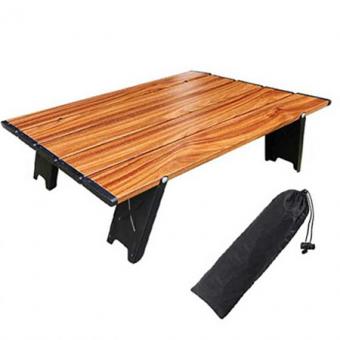
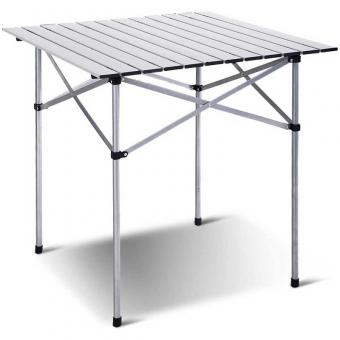
Many flat-pack tables use a slat-and-rail system where individual aluminum slats connect to folding rails. The rails collapse into a compact bundle, while slats stack perfectly flat. This design can achieve packed thickness as slim as 4 cm while supporting weights up to 30 kg .
2. Folding Frame Geometry
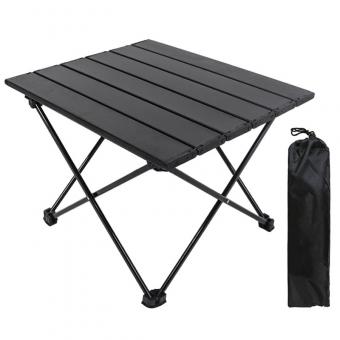
Advanced folding mechanisms allow legs to collapse into the same plane as the tabletop. The scissor-fold design, common in high-end portable tables, reduces packed thickness by 50-60% compared to traditional fold-under legs .
3. Nesting Component Design
Premium flat-pack tables use nested storage where legs fit within recessed channels in the tabletop. This eliminates separate packaging for hardware while protecting components during transit.
4. Material Selection for Thin Profiles
Achieving slim packed dimensions requires materials with high strength-to-thickness ratios:
Aluminum alloy (typically 6061 or 7075) allows for 2-3 mm thick tabletops that remain rigid
Composite panels with honeycomb cores provide stiffness at 5-8 mm thickness
The most immediate benefit of flat-pack design is reduced shipping costs. With 3x more units per container, freight cost per unit drops proportionally. For a typical ocean freight scenario:
Traditional fixed-leg table: $0.65–$0.85 per unit shipping cost
Flat-pack table: $0.25–$0.35 per unit shipping cost
These savings compound across large orders. A container of 3,200 flat-pack tables saves $1,200–$1,600 in freight compared to shipping the same number of traditional tables across multiple containers.
Warehousing Efficiency
Flat-pack tables occupy 70% less warehouse space than traditional designs on a per-unit basis. This translates to:
Lower storage costs
Reduced handling time
Higher inventory turnover capacity
Fewer pallet positions required
Damage Reduction
Traditional folding tables often suffer damage during transit from:
Protruding legs catching on other packages
Uneven stacking causing load concentration
Carton distortion from irregular shapes
Flat-pack designs eliminate these vulnerabilities. Uniform cartons stack securely, and all components are protected within the same envelope.
Beyond Shipping: The User Experience Advantage
The same principles that optimize shipping also benefit end users. Flat-pack camping tables offer:
Compact Storage: Users can store tables in small spaces—under car seats, in closet corners, or between other gear.
Lightweight Carrying: Many flat-pack tables include integrated carrying handles and weigh 2.5–4.5 kg, comparable to traditional designs despite superior packability.
Quick Assembly: Quality flat-pack tables assemble in 30–60 seconds—a minor time investment for significant portability gains.
Versatility: The modular nature of flat-pack designs often allows accessories like table extensions, shelves, or carry bags to pack within the same footprint.
Case Study: Comparing Two Approaches
Traditional Table (Competitor X)
Folded dimensions: 70 x 50 x 12 cm (42 L)
Packed weight: 4.2 kg
Assembly: 15 seconds (legs swing out)
Units per 40ft container: ~1,100
Estimated freight per unit: $0.75
Flat-Pack Table (Optimized Design)
Folded dimensions: 60 x 40 x 5 cm (12 L)
Packed weight: 3.8 kg
Assembly: 45 seconds (rails unfold, slats insert)
Units per 40ft container: ~3,200
Estimated freight per unit: $0.26
Trade-off: The flat-pack table requires 30 seconds longer assembly time but saves $0.49 per unit in freight and occupies 71% less storage space. For a 10,000-unit order, this represents $4,900 in freight savings plus substantial warehousing efficiencies.
Additional Packing Optimization Strategies
Beyond flat-pack design, manufacturers can further optimize shipping through:
1. Nested Carton Design
Custom cartons that exactly match packed dimensions eliminate wasted space and reduce dimensional weight calculations.
2. Color-Coded Component Packaging
When multiple SKUs ship together, color-coded or labeled packaging allows efficient pallet building without opening cartons.
3. Knocked-Down (KD) Hardware Kits
Placing hardware in standardized bags that fit within the main carton eliminates separate packaging.
4. Pallet Optimization
Flat-pack designs enable standardized pallet patterns that maximize container height utilization. A typical flat-pack table carton height of 5–8 cm allows stacking 15–20 layers per pallet.
How to Evaluate Flat-Pack Camping Tables for Your Business
When sourcing or manufacturing flat-pack camping tables, consider these factors:
Factor
What to Check
Why It Matters
Packed Depth
≤ 6 cm ideal
Determines stacking density
Component Integration
All parts fit in one package
Eliminates secondary packaging
Assembly Time
≤ 60 seconds
User experience matters
Weight Capacity
≥ 30 kg
Maintains functionality
Material Durability
6061/7075 aluminum or reinforced composite
Ensures product longevity
Carry Handle
Integrated into design
Enhances portability perception
Common Challenges and Solutions
Challenge: Higher Per-Unit Manufacturing Cost
Flat-pack designs often require more complex tooling and engineering.
Solution: The 2-3x reduction in freight cost typically offsets higher unit costs. For high-volume orders, the savings scale significantly.
Challenge: User Resistance to Assembly
Some consumers prefer "ready-to-use" products.
Solution: Emphasize portability benefits in marketing. Many users gladly accept 60 seconds of assembly for a table that packs 70% smaller.
Challenge: Durability of Folding Mechanisms
More moving parts can mean more failure points.
Solution: Use tested locking mechanisms and include replacement parts in accessory kits. Quality designs withstand thousands of assembly cycles.
The Flat-Pack Future
Flat-pack design represents a convergence of logistics efficiency and user-centered portability. For manufacturers, the 3x improvement in container utilization translates directly to reduced shipping costs, lower warehousing requirements, and a smaller carbon footprint. For end users, these same principles deliver camping tables that fit where others won't—in small car trunks, on crowded camp sites, and in minimalist gear kits.
As the outdoor industry continues to prioritize both profitability and sustainability, flat-pack optimization offers a proven path forward. The next time you evaluate a camping table design, consider not just how it performs at the campsite—but how it travels to get there.
Brand: ANHUI FEISTEL FACTORY Relate Manufacturing: OEM & ODM Product: A lightweight, small, foldable picnic table perfect for outdoor activities. Made of durable materials, it's portable, easy to set up.
Brand: ANHUI FEISTEL FACTORY Relate Manufacturing: OEM & ODM Product: The custom lightweight metal iron foldable moon chair offers durable support and comfort, ideal for outdoor camping, with a compact, portable design for easy transport and storage.
Brand: ANHUI FEISTEL FACTORY Relate Manufacturing: OEM & ODM Product: Compact and lightweight aluminum folding table, perfect for camping, beach, or outdoor activities. Easy to carry, sturdy, and ideal for holding food and drinks.
Brand: ANHUI FEISTEL FACTORY Relate Manufacturing: OEM & ODM Product: This camping foldable wooden lounge chair features a sturdy frame, ergonomic reclining design, and compact folding structure—perfect for relaxing at the beach, campsite, or backyard.
Brand: ANHUI FEISTEL FACTORY Relate Manufacturing: OEM & ODM Product: The hiking backpacking mini stool combines a durable Oxford fabric foldable design with a creative pencil case pocket, offering portability, comfort, and practicality for camping and outdoor adventures.
Brand: ANHUI FEISTEL FACTORY Relate Manufacturing: OEM & ODM Product: An outdoor ultralight single compact portable folding camping bed ideal for backpacking, featuring a durable frame, easy setup, and a convenient carry bag for travel.
Newsletter
Subscribe to our newsletter to receive news, updates, and special offers by email.